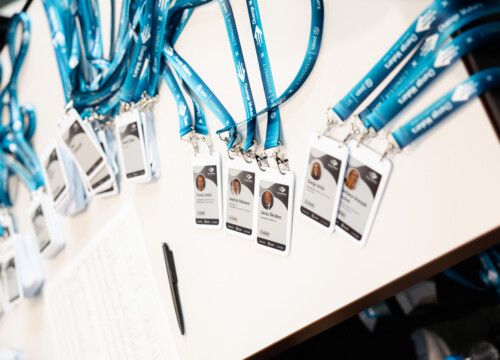
24 Nov 2026
Eco-Friendly Conference Badges
A conference badge gets worn for a day or two, and then most of them end up in a hotel bin or a venue skip. Multiply that by a few thousand attendees, add the plastic holders, the lanyards and the badges printed for people who never showed up, and the smallest item at your event becomes one of the most visible pieces of waste.
That’s why more organizers are looking for eco-friendly conference badges. The options range from recycled paper and seed paper to bamboo, reusable holders and electronic badges you use again at the next event. Some cut waste a lot. Others mostly change what the waste is made of.
This guide compares the main eco-friendly name badges for events, shows where the hidden waste sits, and helps you pick the badge that fits how often you run events and what you need to prove afterwards.
Quickly jump to:
- What makes a conference badge eco-friendly?
- Eco-friendly conference badge options compared
- The waste nobody counts: holders, no-shows and reprints
- Which eco-friendly badge fits your conference?
- How to get badges back so reuse actually counts
- Sustainable name badges: claims you can back up
- How Joan ePaper badges cut conference badge waste
- The greenest badge is the one you don’t make again
- Frequently asked questions
TL;DR
- Eco-friendly conference badges either use better materials (recycled paper, seed paper, bamboo, wood) or get reused across events (reusable holders, write-on badges, ePaper badges).
- Better materials still mean a new badge for every attendee at every event. Reuse is the only way to stop making new badges.
- Much of the waste sits around the badge: plastic holders, lanyards, badges printed for no-shows, reprints and printer consumables.
- For a one-off event, unlaminated recycled paper badges are a sensible, low-cost choice. For events you run every year or every month, reusable badges usually win.
- Reuse only counts if badges come back, so plan the collection as carefully as the check-in.
- Keep reading for a side-by-side table, how to choose by event type, and which sustainability claims you can actually back up.
What makes a conference badge eco-friendly?
An eco-friendly conference badge creates less waste and uses fewer resources over its life than a standard plastic badge in a PVC holder. That comes from one of three things: what the badge is made of, how many times it gets used, and what happens to it after the event.
Most sustainable conference badges you’ll find focus on the first point. Recycled card, plantable seed paper, bamboo and wood all beat new plastic. But each one is still made, shipped, worn once and thrown away (or planted). A badge you use at ten events replaces ten badges, which is a bigger saving than any change of material.
The old waste rule works well here: reduce first, then reuse, then recycle. Print fewer badges. Reuse the ones you have. Make sure whatever’s left can go into a recycling bin, not landfill.
Eco-friendly conference badge options compared
Here are the main options, from single-use materials to badges you use again and again.
Recycled paper and card badges
Badges printed on recycled or FSC-certified card, often as one folded piece with no plastic holder. They look professional, cost little and go straight into paper recycling, as long as you skip the lamination, which makes most paper badges hard to recycle. The downside: they tear in the rain and only last a day or two of heavy wear.
Seed paper badges
Paper with flower or herb seeds pressed into it, so attendees can plant the badge after the event. It’s a memorable touch at a sustainability-themed conference. It’s also fragile, sensitive to moisture and usually a bit more expensive than plain recycled paper. And it only helps if people actually plant it.
Wood, bamboo and cork badges
Natural materials with a premium feel. They’re sturdier than paper and work well for speakers, VIPs or staff. Some bamboo badges are designed to be personalized again with a new label, which makes them partly reusable. They cost more, weigh more and add to shipping.
Reusable holders and magnetic name badges
The classic insert badge, kept instead of thrown away. The holder or frame stays, and only the paper insert with the name changes. Collect your event badge holders at the exit and you can use them again at the next conference. Reusable magnetic name badges work the same way for staff and crew. The frame is reused, but every name still needs a new printed insert. Most clear holders are PVC, which is hard to recycle, so they only make sense if you get them back.
Write-on and dry erase name badges
A badge with a chalkboard or dry-erase surface: the name is written by hand and wiped off afterwards. Dry erase name tags suit small, informal events like workshops, meetups and volunteer days. They’re less practical at a large conference, where names need to be readable across a room and ready before people arrive. For staff badges, see our guide to reusable employee name badges.
Reusable ePaper badges
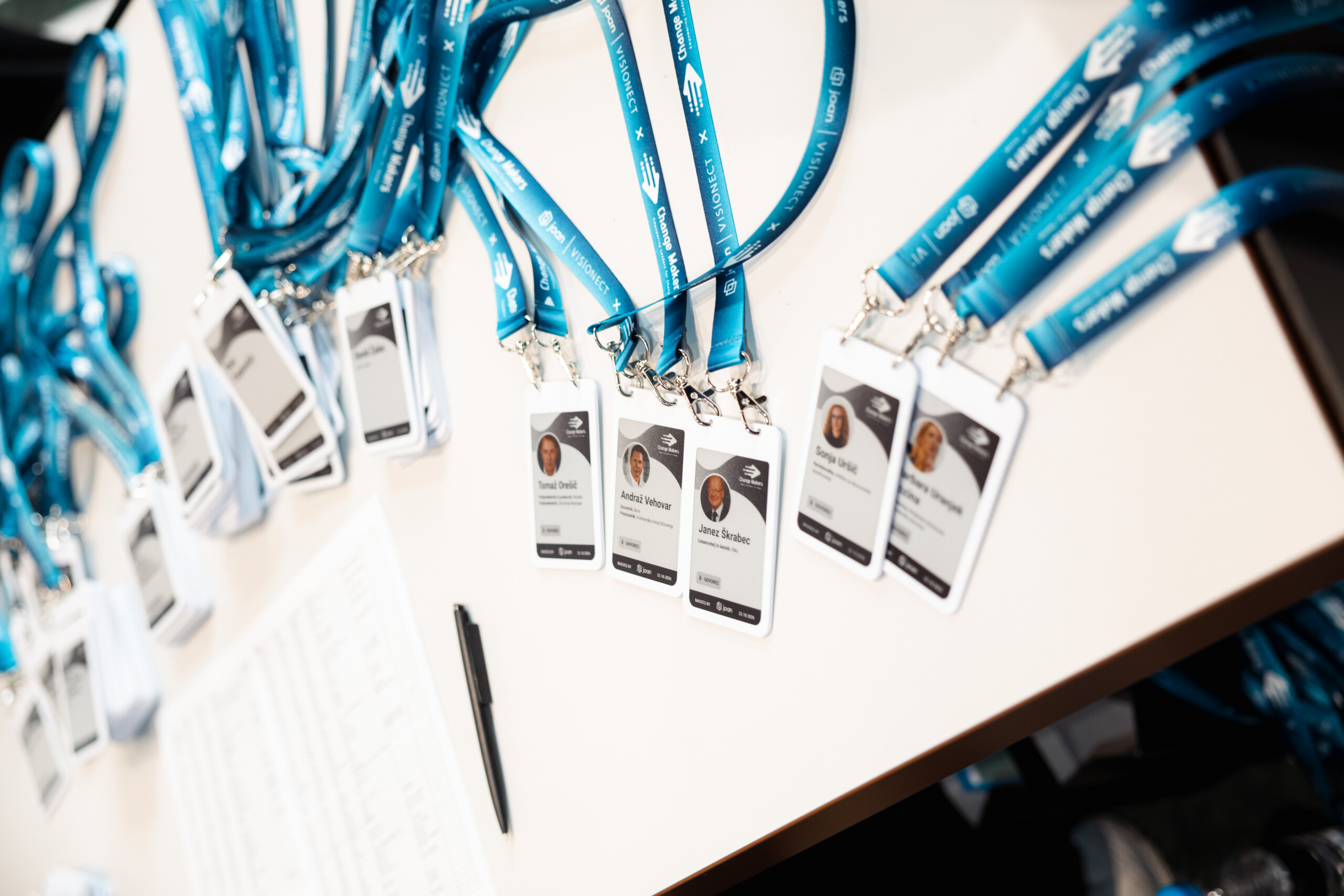
A badge with a small electronic paper screen, the same kind of display as an e-reader. The attendee’s name, company and role are sent to the screen at check-in or prepared in batches ahead of time, and the badge is cleared and handed to someone else at your next event. Nothing is printed, so the whole badge is reused, not only the holder. It has the highest upfront cost, and like any electronic device, it only pays off for the environment if you use it many times and get it back.
Eco-friendly conference badges
What each option reuses, what it leaves behind and where it fits. Single-use cost ranges are US bulk prices for 200 badges from Zoho Backstage’s sustainable badge printing guide, checked in November 2026.
| Badge type | What gets reused | What’s left after the event | Typical cost | Best for |
|---|---|---|---|---|
| Recycled paper or card | Nothing | A paper badge to recycle, if it isn’t laminated | $0.15 to $0.45 per badge | One-off, one or two day indoor events |
| Seed paper | Nothing | A badge to plant or compost | $0.25 to $0.60 per badge | Sustainability-themed events |
| Wood, bamboo or cork | Sometimes the badge, with a new name label | The badge or its label | $0.40 to $1.00 per badge | Speakers, VIPs and smaller premium events |
| Reusable holder with insert | The holder or frame | A printed insert for every attendee | Holder bought once, insert per name | Recurring events that collect holders |
| Dry erase name badge | The whole badge | Nothing, if it’s wiped and kept | Bought once | Small meetups and workshops |
| Reusable ePaper badge | The whole badge, including the name | Nothing, if it’s collected | Hardware plus a yearly license per badge | Organizers who run events often |
The waste nobody counts: holders, no-shows and reprints
Switching badge material is the easy part. The bigger savings often sit in everything around the badge.
- Holders and lanyards. A paper badge in a PVC sleeve on a polyester lanyard is still mostly plastic. Choose paper holders and rPET or bamboo lanyards, or collect them for reuse.
- No-shows. Badges printed in advance for the full guest list include badges for people who never come. Every one of them goes straight in the bin.
- Reprints. A misspelled name, a last-minute speaker or a substitute from the same company each means a new badge, and an old one thrown away.
- Printers and consumables. On-site printing needs printers, ribbons, label stock and backup units, all shipped to the venue and back. One managed on-site printing quote for a 500-person event came to about $13 per badge once printers, stock and staff were included.
- Shipping. Badges printed far away travel to the venue. Printing locally, or not printing at all, cuts that out.
Printing on demand at the desk helps with no-shows, because you only print for people who arrive. A reusable badge goes one step further: an unclaimed badge is simply cleared and used again, and a wrong name is corrected on the badge instead of reprinted.

Which eco-friendly badge fits your conference?
There’s no single greenest badge. The right one depends on how often you run events and whether you can get badges back. For badge types, sizes and design tips, see our guide to name badges for conferences.
A one-off conference
Go with recycled paper or card badges printed on demand, without lamination, on rPET or bamboo lanyards. Put clearly marked recycling bins at the exits. Reusable badges rarely pay off if you’ll only use them once.
An annual conference at the same venue
Reusable holders, or wood and bamboo badges you collect and store, work well here. Ask whether your badge supplier takes back holders and lanyards. If you also run smaller events during the year, the same badges can work there too.
A series of events or a busy corporate calendar
This is where reusable badges make the most sense. Sales kickoffs, partner days, trainings and internal conferences use the same pool of badges again and again, and with ePaper badges you never print a name. The more often you run events, the faster the reuse adds up.
A sustainability-focused event
If sustainability is the theme, the badge is part of the message. Seed paper is a nice symbol, but a reusable badge you can count, collect and report on gives you something more concrete to show.
How to get badges back so reuse actually counts
A reusable badge that leaves in an attendee’s pocket becomes a single-use badge, only a more expensive one. Collection is what makes reuse work, so plan it as carefully as check-in.
- Tell people at check-in that badges are collected at the end, and say it again from the stage.
- Put staffed, clearly marked return boxes at every exit and at the cloakroom.
- Count badges out by type before doors open, and count them back in before you leave the venue.
- At multi-day events, keep the same badge for the whole event and collect it on the last day.
Recovery can be high when it’s planned. Coldplay’s tour, for example, reports getting back 86% of its LED wristbands for reuse, according to Zoho Backstage’s sustainable badge guide. For a full return checklist, see our step-by-step guide to ePaper event badges.
Sustainable name badges: claims you can back up
Clients, sponsors and attendees increasingly ask what an event did to cut waste. “Eco-friendly badges” on a slide doesn’t answer that. Numbers do. Things you can measure and report:
- how many badges you printed, and how many were never collected
- how many reusable badges you issued, and how many came back
- how many times each reusable badge has been used so far
- what happened to the rest: recycled, composted or sent to landfill
Be careful with words like “plastic-free”, “biodegradable” or “carbon neutral”. Use them only if your supplier can show you the paperwork. A recycled badge in a laminated pouch isn’t recyclable, and a compostable badge at a venue without composting ends up in general waste.
If your event follows ISO 20121, the international standard for sustainable event management, ask suppliers for documentation you can attach to your report. Joan event badges are supported by Visionect’s ISO 20121:2024 supplier validation.
How Joan ePaper badges cut conference badge waste
The Joan ePaper badge is a reusable badge with a 4-inch electronic paper screen. Used as one of our event badges, it belongs to you, the organizer, not to the attendee. Here’s what makes it a lower-waste option:
- Reused across events. After each event, badges are collected, cleared, recharged and issued to new attendees at the next one.
- No-shows cost nothing. A badge nobody picks up is cleared and reused, never thrown away.
- Corrections without reprints. A wrong name or a last-minute speaker is fixed in seconds with a resync from the check-in device.
- No printer to run. No ribbons, labels, card stock or backup printers to buy, ship and restock.
- Very low power. ePaper only uses power when the image changes and keeps the image without power, so one charge gives about 700 screen updates.
- Wireless charging. Badges recharge on a standard Qi charger, with no disposable batteries.
- One platform for every badge. Event badges run on the same hardware, app and account as Joan visitor and employee badges, so there’s one system to manage.
At Change Makers 2026, more than 300 guests checked in with Joan ePaper badges, and about 20 badges for walk-ins and late changes were created on the spot in seconds. Read the Change Makers event badge story, or see how the reusable ePaper event badge works from check-in to collection.
To be fair about the trade-off: an ePaper badge is an electronic device with a plastic case and a battery, so it takes more resources to make than a paper badge. Its environmental case rests on using each badge at many events and getting it back every time. The same goes for chip badges, which we cover in our guide to RFID event badges. If you run one event a year, a recycled paper badge may be the better choice.

The greenest badge is the one you don’t make again
Recycled paper, seed paper and bamboo make a single-use badge better. Reuse makes it unnecessary. If you run events often, a badge you collect, clear and hand out again saves more than any change of material, and gives you numbers you can put in your sustainability report.
See how Joan event badges work at conferences and corporate events, check the ePaper badge specs, or talk to us about a pilot at your next event.
Frequently asked questions
What are eco-friendly conference badges made of?
Most are made from recycled paper or card, seed paper, bamboo, wood or cork, often paired with paper holders and lanyards made from bamboo or recycled plastic bottles (rPET). Reusable options are built to last instead: durable holders, dry-erase badges or electronic paper badges that you use at many events.
Are paper conference badges better for the environment than plastic ones?
Usually, yes, if they’re printed on recycled card, aren’t laminated and end up in a paper recycling bin. A laminated paper badge or one in a PVC sleeve is hard to recycle. A durable badge that’s collected and reused many times can beat paper badges that are thrown away after every event.
Are eco-friendly name badges for events more expensive?
Single-use eco badges usually cost a little more than standard paper badges, with seed paper and natural materials at the top of the range. Reusable badges cost more upfront, but you spread that cost over every event where you use them. If you run events often, reuse tends to work out cheaper over time.
Can you recycle conference badges and lanyards?
Unlaminated paper badges can go into paper recycling. Laminated badges, PVC holders and mixed-material lanyards are hard to recycle in most systems, so ask your supplier about take-back programs or collect them for reuse. Badges with RFID or NFC chips belong with electronic waste, not paper.
How do you get attendees to return reusable badges?
Tell them at check-in that badges are collected, remind them from the stage, and put staffed return boxes at every exit. Counting badges out and back in shows you your return rate, so you can improve it at the next event.
Are electronic badges more eco-friendly than paper badges?
It depends on how often you use them. An electronic badge takes more resources to make, but if it’s reused at many events and comes back each time, it replaces a large number of printed badges, holders and reprints. For a one-off event, recycled paper is usually the lower-impact choice.