11 Nov 2026
Workplace Sustainability in 2027: A Practical Guide for Greener Offices
Sustainability has moved from a nice-to-have to a line in the budget. Greener offices cost less to run, help you hire, and matter to customers who check where they spend their money. This guide covers practical ways to improve workplace sustainability in 2027, starting with the changes that give you the most impact for the money.
Technology-driven solutions
Here’s where technology can make the biggest impact in your office sustainability game.
- Lighting intelligence: Those old fluorescent tubes are eating your budget alive. Smart LEDs with daylight sensors cut energy waste by 70% – no more lighting empty rooms.
- Climate optimization: Solutions that actually understands when and where to adjust temperature. Think 25% lower HVAC costs without the thermostat wars.
- Water management: Smart systems that catch leaks before they become floods and recycle water like it’s going out of style (because it is).
- Space utilization: Stop heating ghost towns. Occupancy tracking ensures you’re only powering the spaces people actually use.
- Digital infrastructure: Cloud systems that slash your server room’s power bill and make your IT team’s life easier.
- Workplace experience: Implement digital displays for room booking and app solutions for desk booking that actually make sense – no more paper schedules or energy-hungry screens.
Employee engagement initiatives
Turn your team into sustainability champions – no eye rolls required.
- Hybrid work revolution: Less commuting = smaller carbon footprint.
- Green transport perks: Electric charging stations, bike storage, and transit passes that actually make people want to ditch their cars.
- Department challenges: Monthly competitions with real rewards. Watch how fast people start switching off their monitors when prizes are involved.
- Recognition program: Spotlight your green champions through digital rewards. Because who doesn’t love being called out for doing good?
- Paperless push: Promote the “think before you print” mindset. Your trees (and budget) will thank you.
Green office basics
Transform your office into a green oasis.
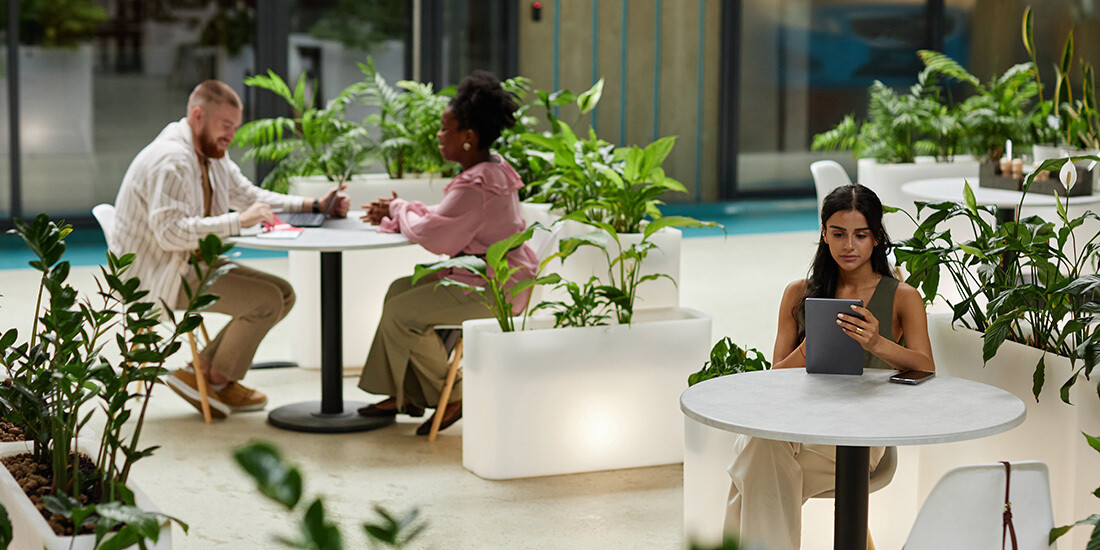
- Biophilic boost: Living walls that purify air naturally, desk plants that energize spaces, and outdoor workspaces that inspire. Nature knows best.
- Mindful materials: Sustainable office supplies that make sense – recycled paper, refillable pens, and eco-friendly cleaning products.
- Natural lighting: Optimize window shades, and watch productivity soar.
- Water wisdom: Simple bottle refill stations, mug libraries for visitors, and real dishes instead of disposables.
- Eco-friendly furniture: Second-hand gems, modular designs, and materials that last.
Measure and report
Every sustainability initiative needs proper tracking. With metrics, you can spot waste, prove ROI, and turn good intentions into real impact. For larger companies in the EU, the Corporate Sustainability Reporting Directive (CSRD) makes this reporting a legal duty. Since the EU’s Omnibus I changes took effect in March 2026, the CSRD covers companies with more than 1,000 employees and more than €450 million in net turnover, and many of them report for the first time on financial year 2027. The directive asks for detailed reporting on environmental impact, including energy use, carbon emissions and waste. Download the Joan CSRD guide to understand how to prepare.
Start with the space you already have
The greenest square meter is the one you don’t heat, cool or light for nobody. In August 2026, 54% of remote-capable employees in the U.S. worked hybrid, according to Gallup. In a hybrid office, many desks and rooms sit empty on most days.
Booking data shows which floors, rooms and desks people actually use. With Joan Desk booking and Meeting room booking, you can see the pattern, then close quiet zones on low days or give up space you don’t need. The room displays run on ePaper, which only uses power when the screen changes.
How industry leaders are winning with sustainable practices
Industry leaders are turning sustainable practices into a powerful competitive edge.
- Spotify: Spotify’s sustainable workspaces features human-centric (HX) lighting technology that adjusts color temperature and intensity throughout the day to match natural circadian rhythms. They also optimised layouts to reduce square footage per employee by 15%.s.
- Salesforce: Their San Francisco headquarters features the largest on-site water recycling system in a commercial high-rise, processing 30,000 gallons of water daily. The blackwater system collects wastewater from rooftop rainwater, cooling towers, showers, sinks, and toilets, saving an estimated 7.8 million gallons of drinking water annually – equivalent to the water consumption of 16,000 San Francisco residents.
- Deloitte: Deloitte’s Amsterdam office, The Edge, stands as a prime example of sustainable architecture meeting smart technology. The building operates through 28,000 sensors that manage daily operations, every workspace is connected to Ethernet-powered LED lighting with sensors, while employees can customize their environment through a smartphone app.
- Etsy: Their Brooklyn headquarters optimizes natural daylight with all workspaces located within 41 feet of windows, while using solar film and manual shades to control glare. They implemented extensive biophilic design, ensuring employees have views of greenery from every seated position, and installed a 3,500-gallon rainwater cistern for irrigation.
The bottom line on workplace sustainability
Smart technology slashes operational costs, while eco-conscious practices attract top talent and boost productivity. From energy-efficient systems to digitized workflows, sustainable offices deliver tangible returns that impact your bottom line.
Start with Joan and make sustainability part of how your office runs every day. Book your demo today and let’s make your workplace work smarter.
Frequently asked questions
What is workplace sustainability?
Workplace sustainability means running your office with less energy, water, waste and travel, while keeping it a good place to work. It covers the building, the technology inside it and the habits of the people who use it.
How can an office reduce its energy use?
Start with lighting and heating or cooling, which use the most energy. Smart lighting with occupancy and daylight sensors, smarter HVAC control, and closing unused spaces on quiet days make the biggest difference.
Does the CSRD apply to my company?
Since the Omnibus I changes took effect in March 2026, the CSRD applies to EU companies with more than 1,000 employees and more than €450 million in net turnover, and to some large non-EU groups. Check with your legal or sustainability team for your exact obligations.