10 Sep 2026
AI in the workplace: What it actually does (And what it doesn’t)
Every few years, a new technology arrives with a promise so large it collapses under its own weight. We’ve been promised the paperless office, the frictionless meeting, the self-managing workspace. Each time, the reality is messier, slower, and more interesting than the headline.
AI is following a similar pattern. The announcements are enormous. The actual deployments are more modest. But somewhere between the hype and the disappointment, there’s something genuinely useful happening — and the workplace is one of the places where it’s showing up earliest.
The honest state of AI in workplace management
Let’s be specific about what AI is doing in workplace technology right now, versus what it’s being marketed to do.
What it’s doing: helping surfaces respond to patterns. AI can look at six months of room booking data and tell you that your large boardroom is booked 80% of the time but actually used 40% of the time — and suggest you either split it or stop offering it as a default booking option. It can notice that a team of twelve consistently books four separate two-person rooms on Tuesday mornings and flag that as a scheduling behavior worth examining. It can process natural language requests — “find me a quiet room for three people near the fourth-floor kitchen tomorrow morning” — and return useful results rather than a blank search field.
What it’s being marketed to do: replace human judgment entirely, manage the workplace autonomously, and solve problems that are fundamentally organizational rather than technological.
The gap between those two things is where a lot of AI implementations go wrong. The tools that work are the ones that augment what the humans in the building are already trying to do, not the ones that try to make the humans redundant.
Where AI actually moves the needle
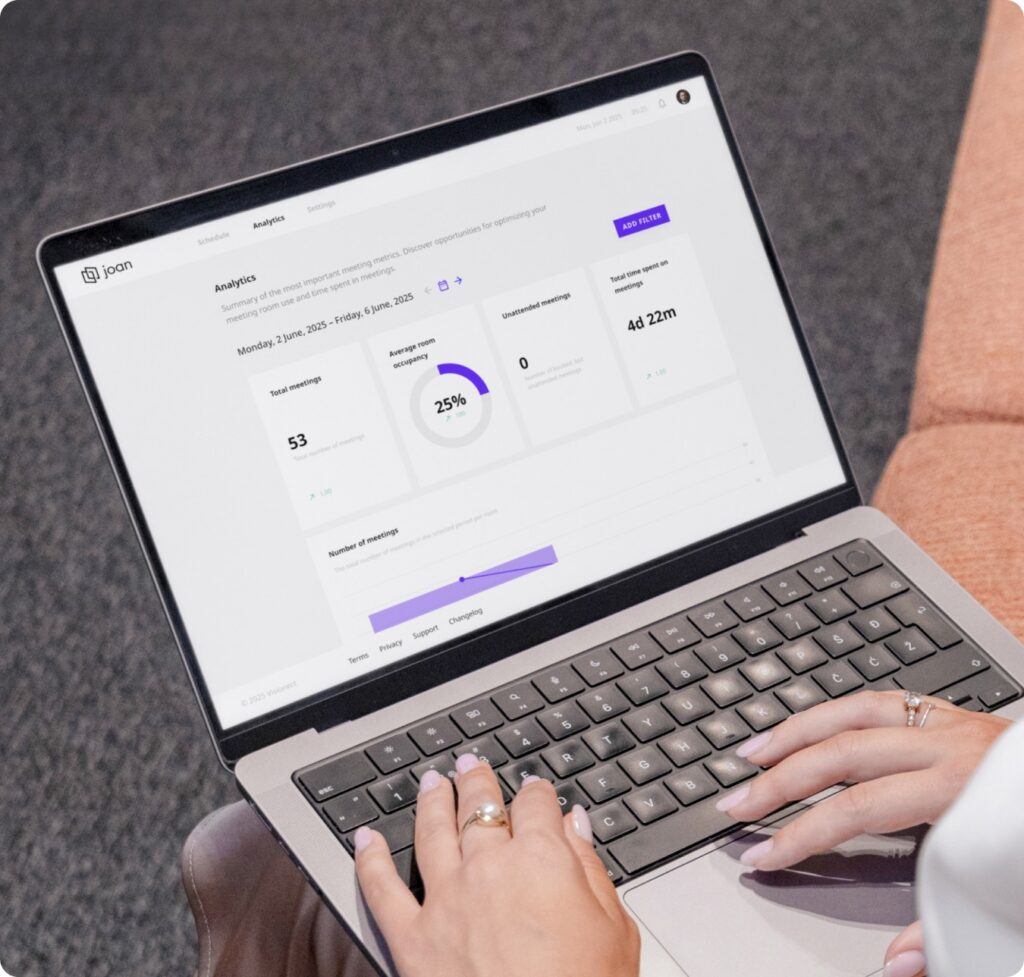
Space utilization is the clearest win. Most organizations operate on a combination of booking data, badge swipes, and intuition when it comes to understanding how their office space is actually used. AI-assisted workplace analytics can build a far more accurate picture — identifying underutilized zones, predicting peak demand, and surfacing recommendations that would take a facilities team weeks to develop manually.
The value isn’t in the AI itself. It’s in what the AI enables: faster, more confident decisions about space that have real budget implications. Reducing your office footprint by 15% based on actual utilization data is a very different conversation from doing it based on a gut feeling.
Scheduling assistance is the second area. Not AI that books meetings for you — that’s still mostly a parlor trick — but AI that reduces the coordination cost of finding time, space, and people simultaneously. When a booking request can be understood in plain language and matched against real-time availability across rooms, floors, and calendars, the friction that currently sits between “I need a meeting” and “the meeting is scheduled” shrinks considerably.
Anomaly detection is underrated. AI watching a stream of workplace events — bookings, cancellations, check-ins, no-shows — can identify patterns that indicate problems before they become visible to humans. A room that’s consistently booked but never checked into might have a broken display. A zone that’s never booked might have a wayfinding problem. A cluster of last-minute cancellations might signal a meeting culture issue. The AI doesn’t fix these things. But it surfaces them fast enough that someone can.
The adoption problem AI doesn’t solve
Here’s the part that doesn’t make it into the vendor decks.
AI in the workplace is only as useful as the data it can access. And in most organizations, that data is incomplete, inconsistent, or siloed in ways that make it difficult to use. Room booking systems that aren’t connected to calendars. Badge access systems that don’t share data with occupancy sensors. Visitor management tools that don’t feed into anything else.
You can’t train a useful AI on bad data. And the work of cleaning up the data, connecting the systems, and establishing consistent processes is not work that AI can do for you. It’s organizational work. It’s slow. It’s unglamorous. It has to happen before the AI layer can do anything meaningful.
The organizations that will get the most value from AI in workplace management are the ones that have already done the boring foundational work: clean data, connected systems, consistent processes. The AI isn’t the starting point. It’s what becomes possible once the infrastructure is right.
Conversational interfaces are closer than they look
One area where AI is moving faster than expected is in conversational booking and workplace assistance.
The idea of asking a chat interface “Is the Boardroom free at 2 PM?” or “Book a desk for tomorrow near the marketing team” and getting a useful, accurate response has been theoretically possible for years. What’s changed is that the underlying models are now good enough to handle the ambiguity, context, and edge cases that made earlier versions feel more like a parlor trick than a tool.
Joan AI Agent for Microsoft Teams is a concrete example of what this looks like when it’s built to actually work. It lives inside Teams as a direct chat — no new app to install for employees, no separate interface to learn. An admin enables it once from the Microsoft Marketplace, and after that, anyone on the team can open a message with Joan and make requests in plain language.
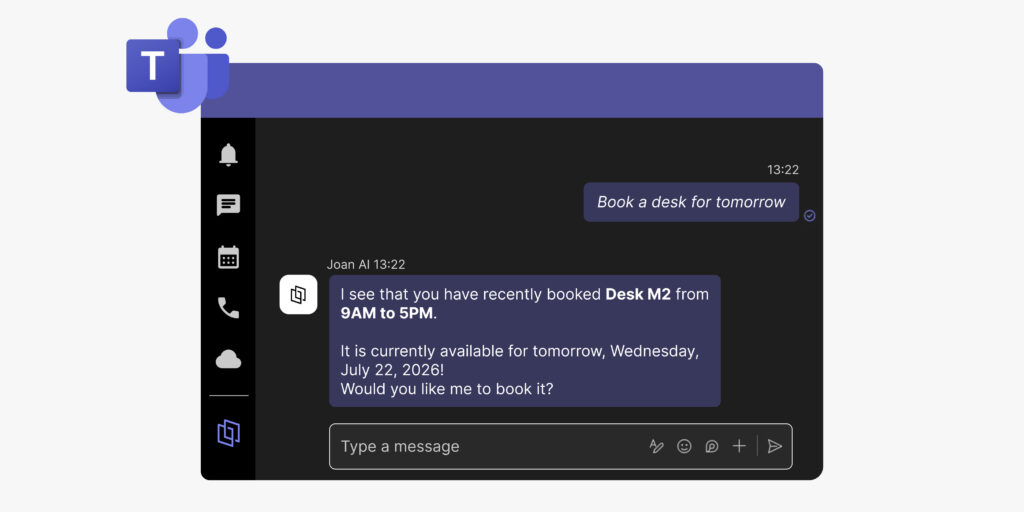
The scope is broader than room booking. In a single conversation, an employee can book a desk, check whether a visitor has checked in, ask which rooms are currently occupied, find out if any devices are offline, and get support answers like how to restart a Joan 6 Pro. Joan doesn’t just retrieve information — it acts on it. “Register a visitor named John Doe for tomorrow at 10 AM” doesn’t return a link to a form. It completes the registration.
What makes this work isn’t the AI in isolation. It’s the AI operating against live Joan workplace data — real room availability, real device status, real visitor records. That grounding in actual data is what separates a useful assistant from a convincing one that’s frequently wrong.
The Microsoft 365 integration matters here specifically because Teams is already where most employees spend their day. The friction reduction isn’t just about speed — it’s about not breaking context. You don’t leave Teams to book a room. You don’t open a separate app to check visitor status. The workplace comes to where the work is already happening.
What to expect in the next two years
AI in workplace management will get more useful before it gets transformative. The near-term gains are in better analytics, smarter suggestions, and lower friction on everyday tasks. The longer-term shifts — AI that genuinely manages workplace operations rather than assisting humans in managing them — depend on infrastructure improvements and organizational readiness that most workplaces haven’t yet achieved.
The organizations that will be best positioned aren’t the ones buying AI platforms today. They’re the ones connecting their systems, cleaning their data, and building the foundations that AI actually needs to work.
That’s not a satisfying conclusion for a technology feature. But it’s an honest one. And in workplace management, honest tends to outperform exciting every time.
Also worth reading: Joan AI in Microsoft Teams: What It Does and How to Set It Up — a practical guide to getting started with conversational workplace management.