14 Jan 2022
How to create a workplace experience for hybrid working
From going fully digital to hopefully landing somewhere between, our workspaces have transformed for good. Where work-from-home protocols were once seen as taboo, they’re now the norm. Still, the amazing thing is that we’re better for it.
Two years ago, the transition to remote work wasn’t a smooth one for many companies. Despite the bumpy road, most organizations agree the shift was effective for the company as a whole. In most conditions, hybrid work has improved productivity, enhanced employee satisfaction, and reduced overhead costs.
In the words of Jack Welch,
“Change before you have to.”
The companies who found the transition to remote working conditions the easiest were the ones who already employed hybrid work protocols. These companies were flexible enough to transition smoothly, hardly missing a beat in productivity and employee conditions.
For hybrid work to run smoothly, companies need to start investing in the right tools to support the shift. With a move toward technology that supports remote working conditions, most companies are migrating toward digital work experiences.
What is a digital workplace experience?
Consider this: remote work has been a general success with little to no framework before the pandemic struck. Imagine how productive hybrid working can be with the best structures in place?
To really thrive, companies will need to invest in a reliable, thorough, and user-friendly digital workplace experience. All resources your teams use to stay connected need to be robust and up for the job.
Companies who adopt and maintain an up-to-date digital workspace benefit from
- Greater talent pool
- Higher employee productivity
- Greater employee satisfaction
- Improved employee retention
- Effective collaboration
When choosing digital tools — such as conferencing platforms, room booking solutions, task planners — companies need to look to the future. Since early 2019, companies have been rushing to piece together solutions that work in the here and now. We’ve been asking, “How can we maintain productivity? How can we facilitate our employees’ work?”
Moving forward, we need solutions that will continue to improve the workplace long term, not just sustain it. We need solutions that will support employee growth, allowing employees to be recognized and move up in the company. Technology should support employee relationships and their connection to the company, enhancing their sense of belonging and security. We need technology that connects people; bridges the gap between remote and in-person collaboration.
We need solutions that are digital without being in the way. Tools that are so effective we hardly know are there…
Why hybrid working teams need a workplace experience
There’s no recipe for hybrid work. If there were, it would be, “mix butter and sugar to taste.” Every company would have a different flavor in mind and a different preference of how sweet or creamy they want their work structure to be.
For some companies, employees will be in the office more than they’re not. For others, the office will just be a collaboration break in their employees’ otherwise remote weeks.
Let’s address the dirty laundry first. While some companies would prefer to have their employees fully in the office, once work-from-home protocols are lifted, employees simply won’t have it. Even Apple, of all companies, has been losing employees for simply mandating that they work in the office three days a week. Many companies are faceing what Deloitte refers to as “the war on talent,” losing top candidates to “greener pastures.”
Why the kickback? Shorter commute times and flexible schedules certainly are two perks of working remotely. However, Microsoft proposes this digital age we’re entering is synchronous with the “personalized age.”
Still, why are most companies opting for hybrid work instead of fully-remote conditions?
Employees want to customize their work experiences. Studies by Gartner have found that employees are more productive with more flexibility. Flexible hours, the freedom to change their physical location, and advanced technology are all factors that have contributed to employee satisfaction and productivity.
With a focus on employee needs, some employees value in-office experiences. Some need a quiet place away from home to work, with few distractions; others get more out of in-person meetings than they do virtually.
Aside from basic employee wants and desires, there are two core principles for why offices spaces are still important:
Culture
Culture impacts numerous aspects of the workplace. For new employees starting at a new company, face-to-face interactions speed up the onboarding process. We’re not just talking about the getting-the-employee-up-to-scratch steps, but the company culture and atmosphere too.
What’s more, companies with poor workplace culture have employees who are stressed, disengaged, and are not particularly loyal to the company. As a result, the company sees lower productivity, higher-than-average workplace injuries, and a high turnover rate.
Maintaining an office for employees to come together in may be essential for your employees to perform at their best. However, have you considered fostering the right culture?
Employees can be trained and brought up to be effective in a digital workspace. Companies can guide and foster the right mindsets and skills employees need to unify technology with their work habits. Overall, it’s important not to undervalue the importance of culture among employees.
Collaboration
Collaboration is the legs every company stands on. Employees need to communicate — and communicate effectively. Since the pandemic began, companies have invested in solutions that foster socialization beyond the regular video call.
Where employees once organically interacted around the office, companies are struggling to recreate the same effect. To Forbes, the future of collaboration is a “leave no one behind” model. It’s essential for all employees, both in office and remote, to feel connected as naturally as possible.
This is where modern technology comes into play. These days, collaboration tools have risen to the challenge, coming out with new, seamless solutions to connect your teams.
Digital solutions for a hybrid workplace
In the words of Microsoft,
“Technology will play a fundamental role in the ability of employers to deliver on the requirements of the ‘personalized age’.”
In other words: it’s time to revamp the office. Companies need to look at their current solutions and consider which ones support an evolving hybrid workspace and which don’t.
Without any inkling the pandemic was on its way, Joan was ahead of the game. We were already brewing up ways to help your hybrid office run as seamlessly as possible.
Most hybrid companies are arranging for employees to come back to the office two to three days every week. Most employees will be coming back to the office on days when their teammates will be present. Therefore, it’s imperative for these offices to have bookable meeting spaces to help teams connect when they’re on site.
Enter Joan: the all-around workplace management system. Joan solutions facilitate hybrid work from home to office. With the best hybrid models, every space is bookable. Meaning, your office needs a robust booking solution.
Through Joan, employees can book any space from meeting rooms to desks. With the Joan app, employees can reserve their spaces remotely before even entering the office.
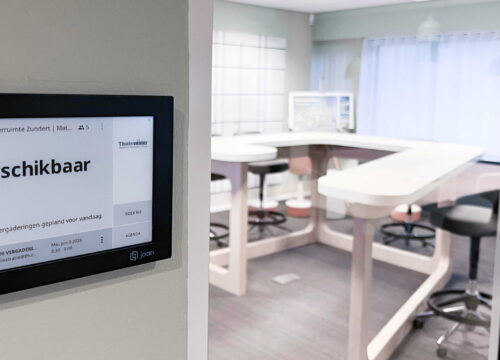
Joan ePaper displays show room availability, eliminating squatters, overrun meetings, and other inconveniences that keep your office from running smoothly.
So far, most companies have minimal experience with hybrid systems. Therefore, it’ll be a journey for office managers to understand which rooms are successful and which rooms are not. Room analytics help managers fine-tune the office experience to be as effective as possible.
To learn more about how Joan can improve your office, contact us today.