
15 Essential Meeting Guidelines for Better Business Results
You know how it goes. A meeting runs long, nobody writes anything down, and you leave unsure what you actually decided. It is not that people do not care. It is that the team never agreed on how their meetings should run.
That is exactly what meeting guidelines fix. They are a simple set of shared rules that keep everyone focused, protect everyone’s time, and turn conversation into real results. Below you will find 15 guidelines you can start using right away, along with a plan to make them stick. Pick a few, try them this week, and watch your meetings get shorter and sharper.
Quickly jump to:
- What are meeting guidelines
- 15 core meeting guidelines for success
- Implementing meeting guidelines for success
- Where Joan fits in with meeting guidelines
- Meeting guidelines FAQ
TL;DR
Meeting guidelines are a short set of shared rules that keep your meetings focused, respectful, and useful. The essentials: send an agenda ahead of time, start and end on time, come prepared, stay present, capture decisions, and confirm who does what next. Start with just two or three of the 15 guidelines below, make them visible to your team, and review what’s working each month. Good meetings are built on simple habits repeated often, not big rule books.
What are meeting guidelines
Meeting guidelines are the ground rules your team agrees to follow before, during, and after a meeting. Think of them as guardrails, not handcuffs. They give your meetings enough structure to stay on track, while still leaving room for real discussion.
Here is a simple way to picture it. Guidelines are the rules you write down, like “always send an agenda” or “start on time.” Over time, those rules turn into norms, which is just a fancy word for the habits your team follows without thinking. You set the rules first, and the habits grow from there. The 15 guidelines below give you a strong place to start.
15 core meeting guidelines for success
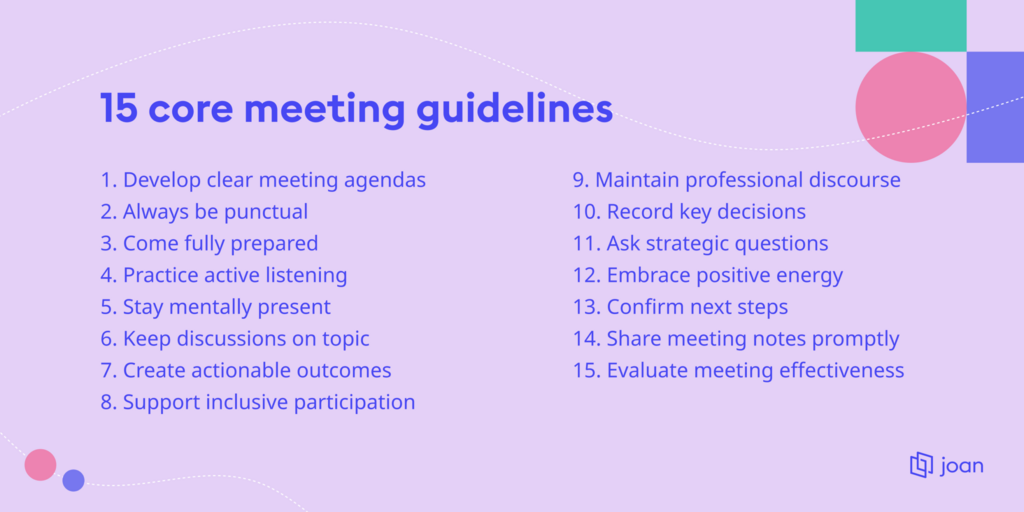
These 15 meeting guidelines provide practical tips for running effective meetings. From better preparation and clear agendas to active participation and follow-through, learn how to make every meeting more focused, productive, and effective.
1. Develop clear meeting agendas
Never run a meeting without a plan. Before you send the invite, write down what you want to cover.
Note how long each part should take. Also write what you want to decide by the end. Share it a day ahead so people can prepare instead of reacting on the spot.
A clear agenda is the single biggest thing you can do to make a meeting better. If you are not sure what belongs on yours, start with our guide on the agenda items every team meeting needs. Then adjust it to fit your team.
2. Always be punctual
When you start late, you quietly tell everyone their time does not matter. Begin at the scheduled minute, even if a few people are still joining. End on time too, and if you wrap up early, hand the time back.
Starting and finishing on time is one of the easiest ways to show your team real respect, and they will notice.
3. Come fully prepared
Read the agenda before you arrive. Do the pre-work. Bring the numbers, the draft, or the update you promised.
When everyone shows up ready, you spend your time together making decisions instead of catching each other up. Preparation turns a slow meeting into a fast one.
4. Practice active listening
Give the person speaking your full attention, and resist the urge to plan your reply while they are still talking. Ask a quick follow-up question to show you heard them. When people feel heard, they share more, and you get better information to work with.
Good listening is not passive. One of the most active things you can do in a meeting is ask questions.
5. Stay mentally present
Close the extra tabs and put your phone face down. Multitasking feels productive, but it means you miss half of what is said and ask questions that were already answered. If a meeting is worth attending, give it your focus. And if you cannot give it your focus, that is a sign you may not need to be there at all.
6. Keep discussions on topic
Even good conversations wander. Your job is to gently steer them back. When someone raises a point that does not fit today’s agenda, write it on a “later” list and move on. You respect the idea without losing the meeting. A simple “let’s park that and come back to it” keeps everyone on track without shutting anyone down.
7. Create actionable outcomes
Every decision needs an owner and a deadline. “We should update the website” helps no one. “Sara will update the homepage by Friday” gets done.
Before you move on from any topic, make sure one person owns the next step and knows when it is due. This one habit is the difference between a meeting that talks and a meeting that moves.
8. Support inclusive participation
The loudest voice is not always the best idea. Make space for quieter people by inviting them in directly: “Maya, what is your take on this?”
This matters even more when some of your team joins remotely, since people on a screen are easy to talk over. Bring in the remote voices first, and you will hear ideas that would otherwise stay unsaid. For more on keeping hybrid teams connected, see our roundup of the hybrid work tools that actually matter.
“Bad meetings almost always lead to bad decisions, which is the best recipe for mediocrity.”
— Patrick Lencioni, author of Death by Meeting
9. Maintain professional discourse
Disagree with ideas, not people. Keep the tone calm and respectful, even when the topic is tense. The goal is not to avoid conflict, it is to keep it healthy. When people feel safe to push back without it getting personal, you get honest conversations and stronger decisions.
10. Record key decisions
Do not rely on memory. Capture the important decisions as you make them, right there in the meeting. Note what you decided, who owns it, and by when. This small habit saves you from the all-too-common argument next week about what the team actually agreed on.
11. Ask strategic questions
A sharp question moves a meeting forward faster than a long explanation. Try “what would make this fail?” or “what do we need to decide today?” The right question cuts through the noise and gets everyone focused on what really matters, instead of circling the same points.
12. Embrace positive energy
Your mood sets the tone, and it spreads. Show up focused and upbeat, and the room follows your lead. You do not have to be cheerful about every topic, but a little energy keeps the meeting moving and makes people glad they came. Flat energy is contagious too, so choose the one you want to pass on.
13. Confirm next steps
Before you close, take one minute to recap. Say out loud who is doing what, and by when. It feels almost too simple, but this quick check catches misunderstandings while everyone is still in the room. One clear minute at the end saves hours of confusion later.
14. Share meeting notes promptly
Send a summary within a few hours, while it is still fresh. List the decisions, the action items, and the owners. Anyone who missed the meeting stays in the loop, and everyone has one clear place to check what they agreed to. Fast notes keep the momentum going instead of letting it fade by the next morning.
15. Evaluate meeting effectiveness
Every so often, ask your team a simple question: are our meetings actually useful? Cut the ones that are not.
Shorten the ones that drag. Combine the ones that overlap. Your meeting habits should get better over time, and the only way that happens is if you check in and adjust.
Implementing meeting guidelines for success
Do not drop all 15 rules on your team at once. That is the fastest way to have none Do not drop all 15 rules on your team at once. That is the fastest way to have none of them stick. Try this simple approach instead.
- Start with three. Pick the three guidelines that would help your team the most right now. For most teams, that is sending an agenda, starting on time, and writing down decisions.
- Explain the why. Share your three rules in your next meeting and say why they matter. People follow rules they understand far more than rules they are handed.
- Make them visible. Put the rules where meetings happen, on the room display, in the calendar invite, or on a one-page reference. A rule nobody sees is a rule nobody follows.
- Give each meeting an owner. One person keeps things on the agenda and on time. Without an owner, even good intentions drift.
- Review once a month. Spend five minutes asking what is working and what is not, then adjust. Good habits fade if you never revisit them.
The teams that make this work usually remove the friction first. When booking a room takes only two clicks, it is easy. Everyone can quickly see which rooms are free.
People stop arguing about scheduling. They start following the rules. The easier you make the right thing, the more often it happens. That is where the right tools quietly do the heavy lifting, so your guidelines have somewhere to live, and your team can simply get on with the meeting.
Where Joan fits in with meeting guidelines
Joan supports these habits with ePaper displays that mount beside each meeting room door. The screen shows whether a room is free or booked, and people can reserve it directly from the display.
The room booking software connects to the calendars teams already use, and shows the day’s schedule at a glance. Because the displays are wireless, you can place them in any meeting room. They give meeting information a clear, visible home.
Meeting guidelines FAQ
How do you run an effective meeting?
Start with a clear agenda, begin and end on time, and keep the discussion focused on what you need to decide. Give everyone a chance to speak, write down decisions as you make them, and finish by confirming who does what next. Afterward, send a summary so nothing gets lost.
How do you conduct a meeting, step by step?
Share the agenda ahead of time so people can prepare. Open by stating the goal, then work through each agenda item in order, keeping an eye on the clock. Invite input, capture decisions as they happen, and close with a quick recap of the action items and owners. Send the notes within a few hours.
What is in a meeting room, and why does it matter for effective meetings?
A typical meeting room has a table, seating, a screen or display for sharing content, and increasingly a camera and microphone for remote colleagues. A room display outside the door shows whether the space is free or booked. Good equipment and clear availability keep meetings running smoothly and prevent double-bookings and interruptions.
What is a meeting agenda?
A meeting agenda is a short plan that lists what you will cover, how long each topic should take, and what you want to decide. It gives the meeting direction, helps everyone prepare, and keeps the conversation on track. Even a few bullet points shared in advance make a noticeable difference.
Is a meeting room the same as a conference room?
They overlap, but they are not identical. “Meeting room” is the broader term for any space used to meet, from a two-person huddle room to a large boardroom. A conference room usually means a larger room built for formal meetings and presentations, often with video-conferencing equipment. In everyday use, many people use the two terms interchangeably.
What are 5 things to include in a meeting agenda?
Include these five: (1) the meeting’s goal, (2) the topics to cover with a time limit for each, (3) who leads each topic, (4) the decisions you need to make, and (5) the action items and owners for follow-up. Keep it short and share it before the meeting.
About the author
