
12 team meeting agenda examples and a free template
The meeting that wanders aimlessly, consuming precious time while accomplishing little. The discussion that circles back on itself repeatedly. The gathering where everyone leaves wondering what exactly was decided. These frustrations plague modern workplaces, turning what should be engines of collaboration into drains on productivity and morale.
But meetings remain essential to organizational success when executed properly. The difference between productive collaboration and wasted hours often comes down to one critical element: a thoughtfully structured agenda.
Whether you’re leading weekly team check-ins or quarterly planning sessions, knowing exactly what items belong on your agenda transforms unfocused gatherings into engines of progress.
TL;DR
- A team meeting agenda is a short plan that lists the meeting’s purpose, the topics, who leads each one, how long each gets and the outcome you need.
- The 7 essential agenda items for team meetings: purpose, review of last meeting’s action items, team updates, core discussion topics, decisions, new action items, and a summary with next steps.
- Mark every agenda item as a decision, a discussion or an update, so people know what’s expected of them.
- Share the agenda at least 24 hours before the meeting, with any pre-reading attached.
- Weekly, monthly, one-on-one, hybrid and async meetings each need a slightly different agenda. Examples for each are below.
- Start with our free team meeting agenda template, and pair it with meeting guidelines your whole team agrees on.
Quickly jump to:
- What is a team meeting agenda
- Core frameworks for productive team meetings
- 12 team meeting agenda examples
- 7 Essential agenda items for every team meeting
- Free team meeting agenda template
- Specialized agenda items by meeting type
- Best practices for creating and following agenda items for team meetings
- From agenda creation to meeting transformation
- Frequently asked questions about team meeting agendas
What is a team meeting agenda
A team meeting agenda is a written plan for a team meeting, shared before it starts. It lists the purpose of the meeting, the topics in order, who leads each one, the time each topic gets and the outcome you need, such as a decision, ideas or a simple update.
The agenda does two jobs. Before the meeting, it tells people how to prepare and whether they need to be there at all. During the meeting, it keeps the conversation on track and gives anyone permission to say “that’s not on the agenda, let’s park it”.
Core frameworks for productive team meetings
Well-crafted agenda items for meetings balance structure with flexibility, ensuring focus while allowing space for unexpected insights.
Start by clearly stating the meeting’s primary purpose at the top of your agenda. This single-sentence declaration acts as a North Star throughout your discussion: “Today we’re finalizing our Q2 marketing strategy with specific channel allocations and performance targets.”
Build with logical structure. Arrange your agenda items in a sequence that builds toward your meeting’s main objective. For each item on your agenda, clearly specify:
- Topic title with brief description
- Desired outcome (Is this for making a decision, having a discussion, or sharing information?)
- Time limit for the discussion
- Required materials participants should review beforehand
End with accountability mechanisms. Complete your framework by including dedicated time for capturing commitments, assigning oners to action items, and establishing how progress will be tracked after the meeting concludes. This final component ensures your meeting creates momentum rather than just conversation.
12 team meeting agenda examples
The 7 essential items stay the same in every meeting. What changes is the middle. Copy any agenda below into your calendar invite or shared doc, change the topics and names, and adjust the times to fit your team.
1. Weekly team meeting agenda
Length: 30 min · Who: the whole team · Best for: keeping work moving week to week
- Quick check-in and one win from each person (3 min)
- Review last week’s action items (5 min)
- Round-robin updates: done, next, blocked (8 min)
- Main discussion topic (10 min)
- New action items, owners and deadlines (4 min)
Tip: If updates take longer than 8 minutes, move them to a written thread before the meeting.
2. Monthly team meeting agenda
Length: 60 min · Who: the whole team, often with the manager’s manager · Best for: looking back and setting priorities
- Welcome and purpose (5 min)
- Results vs. monthly goals (10 min)
- Wins and shout-outs (5 min)
- What we learned this month (10 min)
- Priorities for next month (15 min)
- Open floor (10 min)
- Wrap-up and action items (5 min)
Tip: Send the numbers as pre-reading, so the meeting is spent on what they mean, not on reading them out.
3. One-on-one meeting agenda
Length: 30 min · Who: manager and one team member · Best for: support, feedback and growth
- Check-in: how are things going? (5 min)
- Employee’s topics first (10 min)
- Progress on goals and current projects (5 min)
- Feedback in both directions (5 min)
- Next steps and support needed (5 min)
Tip: Keep one running doc for all your one-on-ones, so open items carry over automatically.
4. Staff meeting agenda
Length: 45 min · Who: all staff in a department or location · Best for: company news and alignment
- Welcome and purpose (3 min)
- Company and leadership news (7 min)
- Department updates (10 min)
- Policy or process changes (5 min)
- Main discussion topic (12 min)
- Q&A (5 min)
- Wrap-up (3 min)
Tip: Collect questions in advance with an anonymous form. You’ll get more honest questions than in the room.
5. Hybrid team meeting agenda
Length: 45 min · Who: a team with people in the office and remote · Best for: giving everyone an equal voice
- Tech check: room camera, mic and screen share, 5 minutes before start
- Welcome, remote attendees introduce first (2 min)
- Review action items (5 min)
- Updates, remote people first (10 min)
- Discussion, with one person watching the chat (15 min)
- Decisions and action items (8 min)
- Wrap-up, share notes and recording link (5 min)
Tip: Book a room with a camera and screen ahead of time, so the first 10 minutes aren’t spent looking for one. (link: /room-booking/)
6. Async agenda (no meeting)
Length: 3–4 days · Who: distributed teams across time zones · Best for: updates that don’t need live discussion
- Monday: the owner posts the agenda and questions in a shared doc or channel
- By Tuesday noon: everyone writes their update (done, next, blocked)
- By Wednesday: comments and questions in the thread
- Thursday: the owner confirms decisions and action items
- Anything still open moves to a short live meeting
Tip: Set a clear deadline for each step. Async without deadlines turns into “no one replied”.
7. Project kickoff meeting agenda
Length: 60 min · Who: project team and key stakeholders · Best for: starting a project with clear goals
- Introductions and roles (10 min)
- Project goal and scope: what’s in, what’s out (10 min)
- How we’ll measure success (5 min)
- Timeline and milestones (10 min)
- Resources and budget (5 min)
- Risks and dependencies (10 min)
- Communication plan and next steps (10 min)
8. Status update meeting agenda
Length: 30 min · Who: project team · Best for: tracking progress on a running project
- Overall status: on track, at risk or off track (3 min)
- Key metrics (5 min)
- Progress since last meeting (7 min)
- Blockers and who can remove them (10 min)
- Upcoming milestones (3 min)
- Wins to celebrate (2 min)
9. Problem-solving meeting agenda
Length: 45 min · Who: the people closest to the problem · Best for: fixing one specific issue
- Problem statement in one sentence (5 min)
- Data and impact (5 min)
- Root cause discussion (10 min)
- What a good solution must do (5 min)
- Options (10 min)
- Decision, owner and next steps (10 min)
10. Strategic planning meeting agenda
Length: 2 hours · Who: leadership or team leads · Best for: quarterly or yearly planning
- Review of last quarter: goals vs. results (20 min)
- Market and competitor changes (15 min)
- What we’re good at and where we’re short (15 min)
- Prioritize opportunities (30 min)
- Resources and budget (20 min)
- Goals and owners for next quarter (15 min)
- Wrap-up (5 min)
11. Retrospective meeting agenda
Length: 45 min · Who: a team after a project or sprint · Best for: improving how the team works
- Set the stage and ground rules (5 min)
- What went well (10 min)
- What didn’t go well (10 min)
- Why it happened (10 min)
- 1–3 changes to try next time (7 min)
- Close (3 min)
12. Admin team meeting agenda
Length: 30 min · Who: office managers, executive assistants, admin staff · Best for: running the office smoothly
- Calendar and scheduling for the week (5 min)
- Office operations: supplies, facilities, maintenance (5 min)
- Visitors, room bookings and upcoming events (5 min)
- Process or policy updates (5 min)
- Open issues (7 min)
- Action items (3 min)
7 Essential agenda items for every team meeting
Certain agenda items belong in virtually every meeting, regardless of purpose or team composition. These foundational elements create consistency and ensure meetings drive real progress:

1. Welcome and purpose statement
Begin by welcoming participants and restating the meeting’s purpose. This brief introduction (60-90 seconds maximum) orients everyone and establishes focus immediately. For example: “Thanks everyone for joining. Today we’re reviewing our Q3 campaign performance and making resource allocation decisions for Q4. By 10:30, we’ll have our final budget distribution and key initiatives identified.”
2. Review of previous action items
Before diving into new discussions, briefly address commitments from your previous meeting. This accountability check takes just minutes but prevents important tasks from slipping through cracks. Keep this review focused on status only – save detailed problem-solving for later agenda items if issues arise.
3. Team updates and progress reports
Allocate time for essential updates, but structure these reports carefully to prevent rambling. Consider a consistent format for all participants: “Share your top accomplishment, biggest challenge, and one resource need in under two minutes.” This approach captures critical information efficiently while maintaining meeting momentum.
4. Core discussion topics
The heart of your meeting, these agenda items address key decisions, problems, or planning needs. For each discussion topic, clearly state:
- The specific question or issue being addressed
- Background context (or pre-reading materials)Th
- e desired outcome (decision, brainstorming, or information gathering)
- Discussion approach and time allocation
5. Decision-making segments
When decisions must be made, dedicate specific agenda time for this purpose. Clearly state the decision method in advance (consensus, voting, or leader’s choice) and establish the timeline for implementation. Creating this separated decision space prevents the common pitfall of detailed discussion without actual resolution.
6. Action item assignment
Never end without clear next steps. Dedicate the final 5-10 minutes to documenting specific actions, including:
- The exact deliverable expected
- Person responsible
- Deadline
- How completion will be communicated
7. Meeting summary and next steps
Close with a brief summary of key decisions and a preview of the next meeting’s focus. This bookend provides clarity and continuity between gatherings.

Free team meeting agenda template
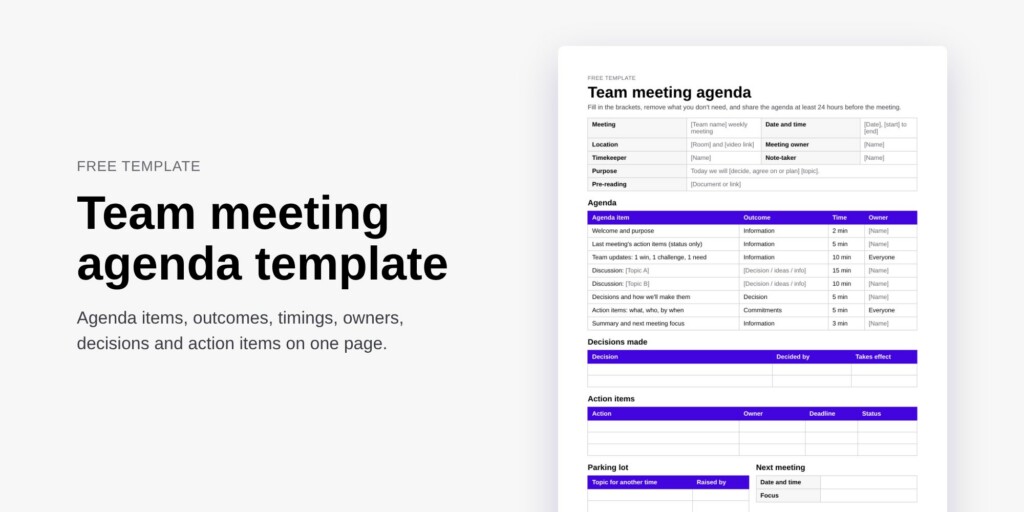
Copy this team meeting agenda template into your calendar invite, a shared doc or your team chat. Replace the text in brackets. Every meeting needs a clear purpose and agreed next steps, but the middle of the agenda changes with the meeting type.
Use this free team meeting agenda template for your next meeting. Fill in the brackets, remove what you don’t need, and share it with your team at least 24 hours before the meeting.
Free to use. No sign-up needed.
Specialized agenda items by meeting type
While certain elements appear in most meetings, different meeting purposes require specialized agenda components:
Project kickoff meeting agenda items
These initial gatherings establish foundations for successful execution:
- Project purpose and scope statement
- Key stakeholder introductions with roles and responsibilities
- Timeline and milestone review
- Resource allocation discussion
- Risk identification and mitigation planning
- Next steps with immediate action items
Status update meeting agenda items
- Regular check-ins maintain alignment without consuming excessive time:
- Progress against key metrics review
- Blockers and assistance needs
- Resource adjustment discussions
- Upcoming milestone preparation
- Brief celebration of wins
Problem-solving meeting agenda items
When tackling specific challenges, structure your agenda to move methodically from understanding to action:
- Problem statement clarification
- Root cause analysis
- Solution criteria establishment
- Decision and implementation planning
- Success metric definition
Strategic planning meeting agenda items
- Forward-looking sessions require different agenda components:
- Competitive landscape review
- Organizational capability assessment
- Opportunity prioritization
- Resource allocation decisions
- Goal and measurement establishment
Best practices for creating and following agenda items for team meetings
Even well-structured agendas deliver value only when implemented effectively:
- Advance distribution creates preparation opportunities. Share agendas at least 24 hours before standard meetings and 72+ hours for significant planning sessions. This advance notice ensures everyone arrives ready to contribute meaningfully.
- Strategic sharing methods increase agenda visibility. Distribute agendas through calendar invites and collaboration platforms using standardized templates. When finding the agenda requires zero effort, preparation compliance rises dramatically.
- Specific preparation guidelines eliminate guesswork. Replace vague instructions (“review the data”) with specific guidance (“review the Q2 dashboard, noting metrics that missed targets by 10%+ and bring one recommendation for each”). This clarity focuses meeting time on insights rather than information sharing.
- Supportive technology enhances agenda effectiveness. Use collaborative document platforms, timer apps, and digital whiteboards to streamline processes without replacing good agenda discipline.
- Accountability systems transform discussions into outcomes. Assign timekeepers, distribute action items within 24 hours, review previous commitments at each meeting, and track completion rates.
From agenda creation to meeting transformation
Creating powerful meeting agendas delivers extraordinary returns: focused discussions that energize rather than drain, decisions that stick, and momentum that builds with each gathering. And while thoughtful content planning matters, don’t overlook the spaces where these conversations happen.
Meeting room logistics might seem trivial, but nothing derails a brilliant plan faster than the dreaded “Is this room actually available?” moment.
Workplace experience solutions like Joan Room Booking eliminate these disruptions with elegant displays showing real-time availability outside every meeting space.
Start your transformation with a single meeting this week. Watch as engagement rises, decisions accelerate, and team members walk away energized rather than exhausted.
Contact us to discuss how our solutions can help with your workplace challenges. Not sure which tool fits your office? Compare the options in our guide to the best meeting room booking systems.
Frequently asked questions about team meeting agendas
What should be on a team meeting agenda?
A team meeting agenda should include the purpose of the meeting, a review of last meeting’s action items, team updates, the main discussion topics, decisions to make, new action items with owners, and a short summary. For each topic, add who leads it, how long it gets and the outcome you need.
What are agenda items?
Agenda items are the individual topics listed on a meeting agenda. A good agenda item names the topic, the person who leads it, the time it gets and the expected outcome, for example “Decide the Q1 events budget (Ana, 10 min, decision)”.
What are the 7 essential agenda items for a team meeting?
The 7 essential agenda items are: welcome and purpose, review of previous action items, team updates, core discussion topics, decisions, action items, and a summary with next steps. Together they move a meeting from context, to discussion, to clear commitments.
What makes a team meeting agenda effective?
An effective team meeting agenda has one clear purpose, an expected outcome and an owner for every item, timings that fit the meeting length, and it’s shared at least a day in advance. If the agenda can’t state a purpose, the meeting may work better as an async update.
What should be on a monthly team meeting agenda?
A monthly team meeting agenda usually covers last month’s results against goals, wins and recognition, lessons learned, one deep-dive topic, priorities for next month and a short team health check. It focuses on the bigger picture and leaves day-to-day updates for weekly meetings.
What should be on a one-on-one meeting agenda?
A one-on-one agenda usually covers how the employee is doing, their own topics and questions, progress on goals, feedback in both directions, growth and career goals, and agreed next steps. Let the employee add their items first, since the meeting is mainly for them.
How long should a team meeting be?
Most weekly team meetings work well at 30 to 45 minutes, and monthly team meetings at about 60 minutes. If you regularly run out of time, move updates to an async channel and keep the meeting for discussion and decisions.
How do you run a team meeting for a hybrid team?
Add the room and the video link to the agenda, start with a quick tech check, let remote participants speak first in updates, and name someone to watch the chat. Keep all materials in one shared link, and book a room with a camera, a screen and good audio.
About the author
