
What your employee badge system should actually do
Most employee badges get people through the front door, maybe log an entry time, and that’s about it. In most cases, the badge doesn’t know whether the person has a desk reserved, whether the meeting room they’re heading to is already double-booked, or whether they’re allowed to access all areas of the building.
As hybrid work changes who shows up on any given day, that disconnect between badge access and actual workplace coordination is getting harder to ignore.
Quickly jump to:
- What do employee badges do in a modern workplace?
- How do employee badges work?
- Types of employee badges: physical, digital, and ePaper
- How to choose the right employee badge system
- Why visitor badges matter for workplace security
- How Joan Workplace supports badge-connected workplaces
- Frequently asked questions about employee badges
TL;DR: Employee badges have moved well beyond plastic ID cards. Modern systems tie into access control, visitor coordination, and space management. The real value shows up when the badge connects to the systems that run the physical workplace, not just the front door.
What do employee badges do in a modern workplace?
Employee badges started as laminated paper cards with a name, title, and employee number. Over time, they picked up magnetic stripes, barcodes, and RFID chips. Today, the best systems go further, combining identification, physical access control, time and attendance tracking, and visitor differentiation into a single badge.
The shift matters because badge data has become an operational input. According to CBRE’s 2026 Global Workplace Occupancy Benchmarking Program, 71% of employers now measure office presence through security badging. The badge swipe is no longer just a security event. It’s a data point that feeds into how organizations plan and manage their physical spaces. first time to your facilities team reviewing access records at the end of the day.
How do employee badges work?
The basic idea hasn’t changed much: a badge carries a credential, and a reader verifies it. What’s different now is how that credential is stored and what happens with the data it generates.
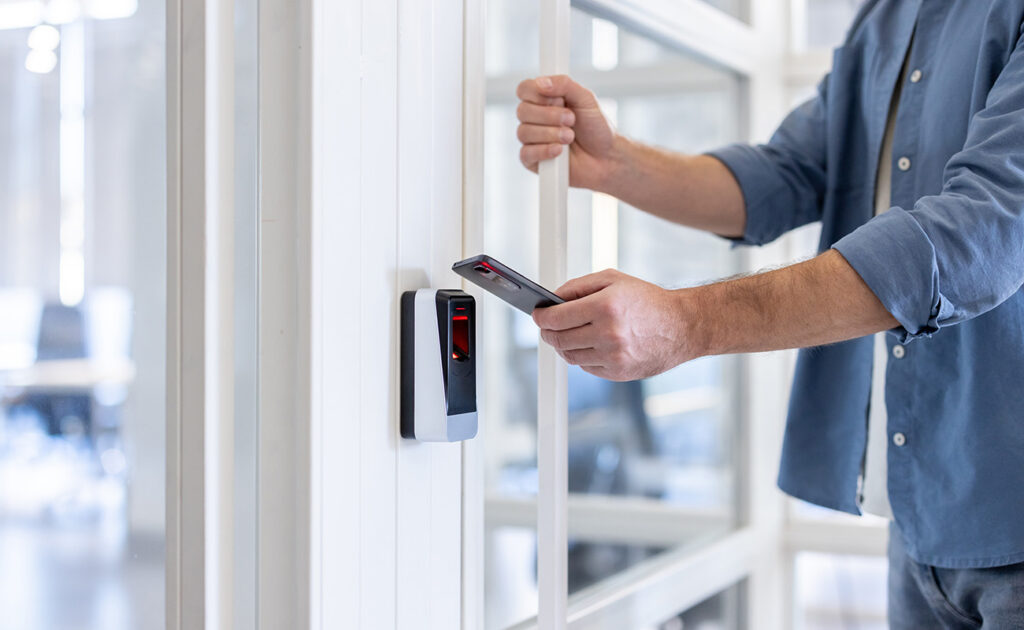
RFID badges use a small chip and antenna embedded in the card. When held near a compatible reader, the chip transmits a unique identifier over radio frequency. The reader checks that ID against a database of permissions and either grants or denies access. Most office badge systems use passive RFID, meaning the card has no battery and draws power from the reader’s electromagnetic field.
NFC (near-field communication) works on a similar principle but at a shorter range, typically a few centimeters. NFC is the technology behind most mobile badge systems, where a smartphone replaces the physical card. The phone stores an encrypted credential and transmits it to the reader through the same tap-to-unlock gesture.
Barcode and QR-based badges take a simpler approach. The badge displays a printed or digital code that a scanner reads optically. These are cheaper to produce but easier to duplicate, which makes them more common for visitor passes than permanent employee credentials.
Behind the reader, an access control system logs every interaction: who badged in, where, and when. That log feeds into time and attendance tracking, occupancy reporting, and security audits. In more connected setups, badge events can trigger downstream actions like adjusting HVAC for occupied floors or updating a live headcount dashboard.
Types of employee badges: physical, digital, and ePaper
Physical employee badge cards
RFID and barcode-based cards remain the most common format. They’re familiar, easy to issue, and compatible with most legacy access control hardware. The trade-off is durability (cards wear out, get lost, and need reprinting) and limited security. A physical card can’t confirm the right person is using it.
Digital and mobile employee badges
Digital badges store credentials on a smartphone, often through an app or a wallet like Apple Wallet. They eliminate printing costs, update instantly when someone’s role or access level changes, and add a layer of security through the phone’s own biometrics or passcode. For organizations with high turnover or frequent onboarding, the savings add up quickly.
ePaper employee badges
Some organizations are combining physical and digital formats. ePaper badges, for example like the Joan ePaper Badge, use low-power displays that update wirelessly. They’re reusable, display dynamic content, and sit somewhere between a traditional card and a fully digital credential. This format is especially promising for visitor identification, where single-use paper or plastic badges create waste without adding much security.
How to choose the right employee badge system
Security and access control
Physical access remains the primary function. But the type of badge matters. Digital credentials are harder to steal and misuse than physical cards because they’re protected by the device’s own security layer. Unless the cards showcase important identification and security data.
Integration with workplace and HR tools
A badge system that syncs with calendar tools, HR platforms, and space management software saves time and reduces manual coordination. When someone’s role changes, their access should update automatically. When a new hire starts, their badge should already reflect the right permissions.
Replacement costs and long-term ROI
Physical cards cost money to print, reprint, and replace. Digital badges eliminate most of those costs. For organizations with frequent personnel changes, the savings compound over time.
Environmental impact
PVC badge cards are part of that waste stream. Reusable alternatives, whether digital credentials or ePaper badges, reduce the volume of single-use plastic an organization generates.

Why visitor badges matter for workplace security
Employee badges get most of the attention in access control conversations, and for good reason. But visitor credentials deserve the same level of thought. Every person who walks into your building without a verified badge is a gap in your security posture, and in most offices, that happens dozens of times a day.
Paper visitor badges have been the default for decades, but they come with real limitations. They’re easy to fake, they don’t connect to any verification system, and they generate daily waste. A paper sticker with a handwritten name doesn’t tell security whether the visitor has signed the required NDA, who their host is, or whether they’re still checked in. And once that sticker is issued, there’s no way to revoke it remotely or track where the visitor has gone inside the building.
Digital visitor badges offer the same kind of security as employee badges. Reusable ePaper visitor badges, for example, update automatically during check-in. The visitor registers at a reception tablet, and their name, photo, company, host, and check-in time are pushed to the badge wirelessly. The credential is tied to that specific visit, so there’s no carryover from previous entries and no ambiguity about who is authorized to be on-site. When they leave, the badge is returned, cleared, and ready for the next guest.
For facilities and security teams, the difference is operational visibility. Every visitor check-in creates a verifiable record, every badge is accounted for, and every credential expires the moment the visit ends. The result is a visitor experience that’s professional and auditable, without the waste of single-use alternatives.
How Joan Workplace supports badge-connected workplaces
Most badge systems handle identification and door access. Where they fall short is connecting badge data to the rest of the workplace. An employee swipes in, but the system doesn’t know whether they have a desk reserved, which floor they should head to, or whether the meeting room they booked is actually available.
Joan Workplace offers more than a simple badge infrastructure and fills that coordination gap. When employees check in to the building, Joan’s platform already has their desk reservation, room bookings, and parking spot sorted.
Joan also offers reusable ePaper badges that work for both employees and visitors. For employees, the badge can display name, photo, department, and role, updating wirelessly whenever details change. No reprinting, no manual updates. For visitors, the same badge technology pairs with Joan Visitor management system to show guest details, host info, and check-in time, replacing paper and PVC alternatives with a credential that resets automatically after each visit.
Want to see how Joan fits into your badge setup? Connect with Joan Workplace specialists to explore how ePaper badges and the platform work alongside your existing access control.
Frequently asked questions about employee badges
What should an employee badge include?
At a minimum, an employee badge should display the person’s name, photo, job title, and company branding. Depending on the system, it can also carry access credentials (RFID, NFC, or digital), emergency contact information, and role-based access permissions. Digital badges can include additional layers like certifications and training records.
How do employee badges work in hybrid offices?
In a hybrid setting, badge data becomes a planning tool as much as a security tool. Badge swipes show who is in the building and when, which feeds into occupancy analytics, desk allocation, and resource planning. The most useful systems connect badge data to booking and scheduling platforms so that space management reflects actual attendance, not just headcount.
What’s the difference between employee badges and visitor badges?
Employee badges are permanent credentials tied to an individual’s role, access level, and employment status. Visitor badges are temporary and issued for the duration of a single visit. The key difference is lifecycle. Employee badges are maintained and updated over time. Visitor badges need to be issued quickly, display relevant information (host, check-in time, access restrictions), and be returned or deactivated at checkout. Reusable ePaper badges are bridging this gap by offering a professional, sustainable visitor credential that updates dynamically with each new guest.
About the author
