
Workplace Technology Trends
As organizations continue to refine hybrid work strategies, digital workplace technology is becoming essential for creating efficient, flexible, and data-driven office experiences.
From simplifying desk and meeting room bookings to providing real-time insights into how spaces are used, these tools help organizations make better decisions about their workplaces.
To understand where workplace technology is heading, we combined insights from conversations with customers and partners, emerging industry developments, and our own product roadmap. The result is a clear view of the trends shaping modern workplaces. Here are eight workplace technology trends to watch in 2026 and how they are redefining the future of the office.
TL;DR
Workplace technology in 2026 is less about buying new tools and more about connecting the ones you already have. Eight trends to watch:
- AI agents start doing the work — booking rooms, resolving calendar clashes, and writing up meeting notes instead of just answering questions.
- Air quality joins occupancy data — temperature, noise, and ventilation metrics move into the same dashboard as utilization.
- Hardware gets simpler, not fancier — battery-powered ePaper replaces power-hungry tablets and kiosks.
- Space management turns predictive — forecasting next Tuesday’s rush instead of reporting on last week.
- Point solutions consolidate — desks, rooms, visitors, and parking on one platform instead of four logins.
- Space data reaches real estate decisions — occupancy trends now inform lease renewals, not just daily operations.
- Sustainability shifts from measuring to automating — occupancy data drives HVAC and lighting in real time.
- Signage and visitor management merge — lobby displays, badges, and room screens pull from the same live data.
1. AI agents start doing the work, not just answering questions
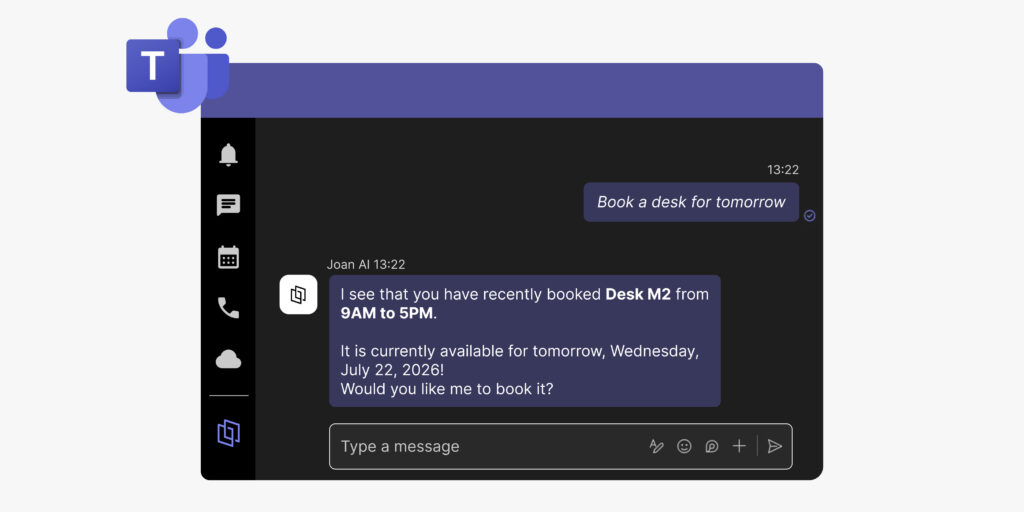
For a while, AI in the office just meant a chatbot that was there to answer questions, but that’s changing fast. Agents are now clearing scheduling conflicts, summarizing meetings, and recommending an open room before anyone even opens the app.
According to Microsoft’s 2025 Work Trend Index, 41% of employees say their company is already using AI agents to automate parts of the business. That’s not a pilot program anymore. That’s how work is starting to get done.
Right now, the clearest wins are in small, simple jobs: booking a room, sorting out a calendar clash, writing up meeting notes. Nothing complicated, just less to keep track of. Joan’s been part of that shift for a while now, Joanbot is listed directly on Microsoft’s own marketplace, built to book a room the moment someone messages it in Teams, no separate app, no extra login. The newer Joan AI Agent takes that same idea further, acting like an extra pair of hands across more of the small, everyday logistics, not just booking rooms.
2. Indoor air and comfort data start joining the same system
Occupancy remains a foundational workplace metric, but on its own it only tells part of the story. Organizations are increasingly combining occupancy data with environmental metrics such as air quality, noise levels, temperature, and lighting to gain a more complete understanding of how their workplaces perform.
The goal is not simply to measure space utilization. It is to create healthier environments, improve employee experience, and make better-informed workplace decisions.
Poor indoor air quality has been linked to significant productivity losses, with one industry report estimating that inadequate ventilation costs U.S. businesses $22.8 billion annually in sick leave alone. Research also shows that 57% of employees consider temperature and airflow the workplace conditions that have the greatest impact on their productivity, ranking them above desk comfort and lighting. Meanwhile, 83% say visible efforts to improve air quality and workplace comfort would make them feel more valued by their employer.
What is changing is not just the availability of environmental data, but also how organizations use it. Instead of existing in separate building management systems, environmental insights are increasingly integrated with occupancy, room booking, and workplace analytics platforms. This allows workplace and facilities teams to evaluate spaces based on both availability and quality. A meeting room may be available according to the booking system, but if poor ventilation or excessive noise affects the experience, it is not an effective space for collaboration.
Combining occupancy and environmental data provides a more complete view of workplace performance and helps organizations make smarter decisions about how office space is managed and optimized.
This version also avoids rhetorical phrasing like “the next honest step,” which tends to be less common in enterprise B2B content, and instead focuses on practical business outcomes.
3. Hardware gets simpler, not fancier
The hardware trend this year isn’t more features, it’s less to maintain. Power-hungry tablets and clunky kiosks are on their way out. In their place are devices built for one job, and built to disappear into the background.
ePaper didn’t really get better recently, offices just started needing what it’s always been good at. A few things happened around the same time: hybrid work meant spaces needed to show their status in real time, sustainability stopped being optional, and the hardware itself got better, color, bigger screens, wireless that actually works. ePaper (E-ink) displays are what came out of all that.
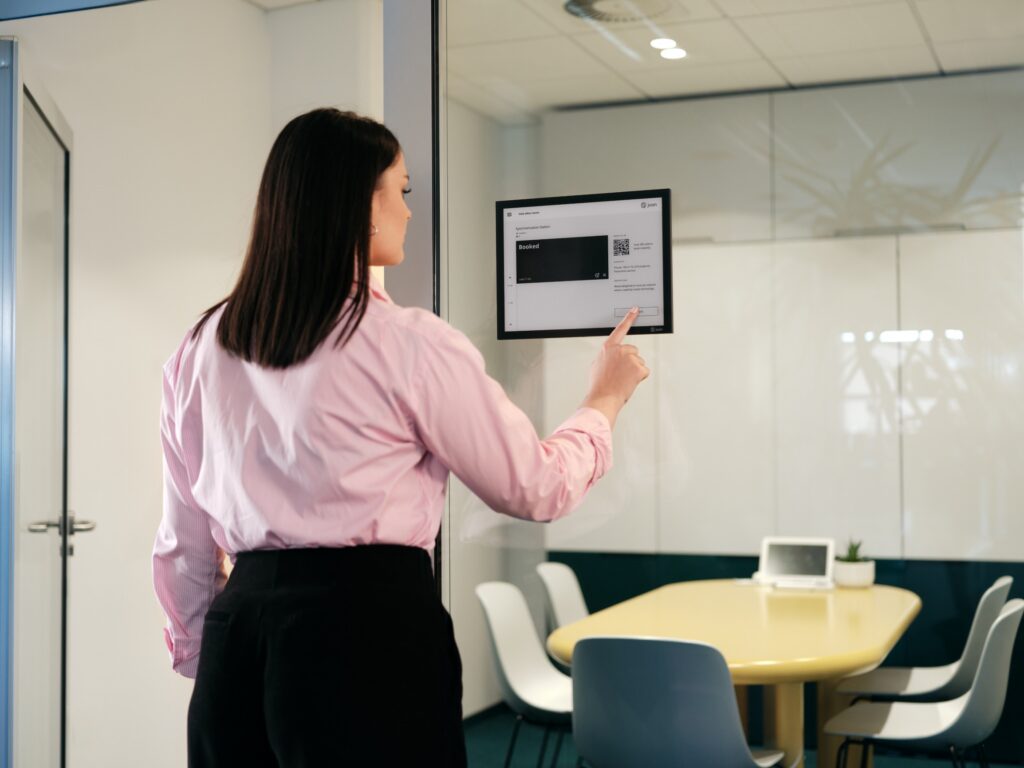
What is an E-Ink display and how does it work?
Normal screens work by shining a backlight through their pixels constantly, whether the image is changing or not. E-Ink works differently. It uses tiny charged particles that move only when the image needs to change. Once something appears on the screen, it stays there without using power until the next update.
That’s the key difference. Because the display only uses power when the image changes, a battery can last for months instead of days. The screen is also matte rather than backlit, making it easy to read in bright light or direct sunlight, conditions where a regular tablet can struggle.
Of course, E-Ink isn’t designed for everything. If you need video, animations, or a constantly updating dashboard, an LCD is still the better choice. But for something like a sign that changes only a few times a day, running an LCD continuously just to display a mostly static image doesn’t make much sense.
It’s also worth looking closely at any “low-power” claim. If a display still needs to be plugged in or recharged every day or two, it’s not really solving the problem that ePaper is designed to solve.
That’s why E-Ink keeps appearing on these lists. Not because it’s flashy, but because it simply keeps working. Some of these displays have been running in the field for nearly nine years.
It also suits the way floor plans change in a hybrid office. A battery-powered, wireless display can be moved to a new location in minutes, without needing an electrician or new wiring.
4. Predictive space management moves past just showing what’s free
Real-time visibility solved the obvious problem, knowing what’s free right now. The next step is knowing what you’ll need before you need it.
Most companies already have the raw material for this without realizing it. Research from Ronspot found that 74% of organizations already collect utilization data, but only 7% rate their own ability to actually use that data as excellent. The data is there, it’s just sitting unused. Johnson Controls found something similar from the other direction, organizations tend to overestimate their own utilization by 35 percentage points or more, believing a floor runs at 75% capacity when it’s actually closer to 40%.
Predictive tools close that gap by turning history into a forecast instead of a report. Upflex, for example, says its platform forecasts office attendance with 97% accuracy, which is enough to plan staffing, cleaning, and room allocation around a Tuesday rush before it happens, rather than reacting to it after the fact. It’s the same booking and occupancy data companies are already collecting, just used one step further forward. That’s the direction Joan Analytics is headed too, from telling you what happened last week to telling you what’s coming next week.
5. Point solutions give way to one connected platform
A few years back, offices ran on a pile of separate tools. One for desks, another for rooms, another for visitors, another for parking. Each one did its job fine on its own, but stitching them together meant separate logins, disconnected data, and no real view of how the office worked as a whole.
That’s shifting now, toward one platform that connects everything, so a desk booking pattern, a room usage trend, and a visitor log all feed into the same decisions instead of sitting in separate silos.
That’s really what digital workplace technology looks like in practice, fewer systems, less duplicated work, and a single place where all that data actually connec@Nenad Radoja the pages you have linked that need my action are in fact redirected pages for quite some time now… so they do not exist
6. Space data starts driving real estate decisions
Combine desk bookings, room reservations, and occupancy sensors, and you get a clear picture of how space is really used, not how it was designed to be used. That’s increasingly showing up in decisions about renewing a lease, downsizing a floor, or redesigning a layout, and not just for day-to-day operations. Real estate teams are using this kind of data to decide whether a lease renewal makes sense at all, or how much space a growing team actually needs versus how much they assume they need. Guesswork gets expensive fast when it’s baked into a ten-year lease.
7. Sustainability moves from measuring impact to automating it
Sustainability reporting used to be the finish line. In 2026, it’s the starting point. Instead of just tracking impact after the fact, more organizations are using occupancy data to run their buildings differently in real time.
More than 45% of commercial real estate portfolios in the US have already committed to smart building upgrades, according to a recent market report, with energy efficiency named as the leading driver. Lighting and HVAC are the clearest places this shows up. Heating and cooling a floor as if it’s fully occupied when it’s actually at 40% capacity is an easy cost to miss, and exactly the kind of thing real-time occupancy data fixes automatically.
It’s the same idea we apply to our own hardware. Our ePaper displays only draw power when something actually changes, so the devices running on top of all that occupancy data barely add to the load themselves.
8. Visitor management and signage join the same system
Digital signage and visitor tools are increasingly part of the same platform as desk booking and room booking solutions, so a visitor arriving for a meeting, a wayfinding display in the lobby, and a room status screen down the hall are all pulling from the same real-time data instead of three separate systems that don’t talk to each other. ePaper badges are part of that same picture, and the same idea is extending to employees too, not just visitors, so even what someone’s wearing on a lanyard is drawing from the same live data as the screen on the wall.
It’s a small shift on paper, but it changes the experience of walking into a building for the first time, and it’s one less system for facilities teams to manage separately. A visitor who checks in on a badge that’s already synced with the meeting they’re attending, and gets directed to the right floor by the same signage system that shows room availability, notices the difference even if they can’t name what changed.
Everything works better connected
When these eight trends are viewed together, a clear pattern emerges: no single technology can operate effectively in isolation anymore. The true shift for 2026 is not centered on acquiring another standalone application, but on implementing one platform that connects everything you already utilize.
For example, the utility of an AI agent increases dramatically when room bookings are coordinated with real-time air quality metrics. Likewise, space occupancy insights provide far greater value when tied directly to the scanned badge and the precise desk an employee chooses to work at, rather than merely the initial reservation. Wall-mounted ePaper displays similarly depend on this unified stream of live data to be genuinely functional. Ultimately, the most successful offices this year will not be those with the greatest volume of software, but those where every system finally communicates seamlessly with the others.
Connect with Joan Workplace specialists to explore how the platform fits your team’s specific needs.
About the author
